



A Schengen visa rejection can feel frustrating because most travellers do not apply carelessly. The documents are collected, the appointment is arranged, the bank statement is printed, the hotel booking is attached, and the insurance is ready. Still, the application may come back refused.
This usually happens because a Schengen visa file is not assessed as a simple folder of papers. It is reviewed as a complete travel profile. The consulate needs to understand whether the traveller is eligible to apply, whether the documents are correct, whether the travel plan is believable, whether the trip is financially supported, and whether there is a clear reason to return after the visit.
For travellers applying Schengen visa from Qatar, this needs extra care. Passport validity, QID validity, residence status, bank statement strength, salary consistency, sponsor support, itinerary logic, previous refusals, and travel history can all influence how the file is understood.
At Fahed Tourism, we look at Schengen visa preparation as a clarity exercise.
The strongest applications are not always the thickest. They are the ones where every document supports one clear, realistic, and well-prepared travel story. Visa requirements can change, and Schengen document checklists may differ by country and traveller profile. Before applying, travellers should always check the latest requirement of the Schengen country they are applying through, so the file is prepared with the most current details. With that in mind, here are the common reasons Schengen visa applications get rejected, and the practical steps that help avoid them.
1. Passport, QID, and Basic Eligibility Issues
Before the travel plan or financial documents are reviewed, the first question is simple: can the traveller apply properly with the documents they currently hold?
1.1 Passport validity, issue date, and blank pages
A passport can still be valid for general travel, but not suitable enough for a Schengen visa application. As a safer preparation standard, the passport should ideally have at least 6 months validity at the time of application. It must also meet the official Schengen passport requirements, including validity for at least 3 months after the intended departure from the Schengen area, at least two blank pages, and issue within the previous 10 years.
This can become a problem when the passport is close to expiry, damaged, unclear, missing blank pages, or when the details do not match the visa form, flight booking, hotel booking, insurance, or QID.
To avoid this risk, check the passport before booking an appointment. If the passport is close to expiry, renewing it first may be the safer step before preparing the visa file.
1.2 QID validity and Qatar residence status
For non-Qatari residents applying from Qatar, QID validity should be checked early. The QID supports the applicant’s legal residence in Qatar and helps confirm that the traveller is applying from the correct country of residence.
As a safer preparation standard, the QID should ideally have at least 6 months validity at the time of application. This gives more room for appointment availability, processing time, travel dates, and possible additional document requests.
At minimum, the QID should meet the latest requirement of the Schengen country being applied through. Some Qatar-based Schengen requirements refer to legal residence in Qatar being valid for at least 3 months beyond the intended departure from the Schengen area or at least 3 months after the return date.
This section matters because passport and QID issues are foundation-level risks. Once the traveller’s basic eligibility is clear, the next step is checking whether the technical documents are correctly prepared.
2. Incorrect Forms, Photos, Insurance, and Technical Documents
Some applications are weakened not because the traveller has a poor travel reason, but because the file has technical mistakes. These mistakes can make the application feel rushed, incomplete, or inconsistent.
2.1 Application form and personal details
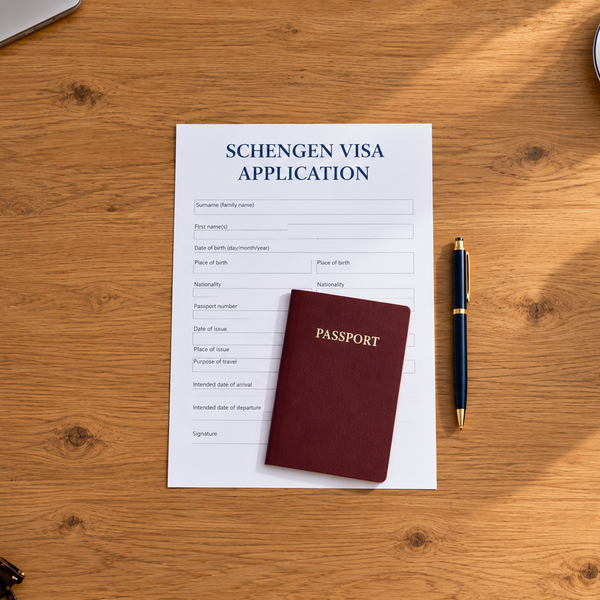
The visa application form should match the supporting documents. Travel dates, passport number, nationality, destination, number of entries, employment details, sponsor details, and accommodation information should be checked carefully.
A missing signature, wrong passport number, incomplete field, or incorrect travel date can create unnecessary doubt. If the form shows one travel period, the hotel booking shows another, and the insurance starts on a different date, the file immediately becomes less clear.
2.2 Photo, biometrics, and document format
A Schengen visa photo should be a recent biometric passport photo, usually 35 x 45 mm, taken with a clear front-facing view on a plain white or bright background. The face should be clearly visible, the photo should reflect the traveller’s current appearance, and digitally altered photos should be avoided.
Old photos, incorrect size, unsuitable background, unclear prints, covered facial features, or photos that no longer match the traveller’s appearance can create avoidable issues. Biometrics and supporting documents should also follow the latest requirement of the Schengen country being applied through, including clear copies, valid document dates, and translations where required.
2.3 Travel medical insurance
Travel insurance is not a small add-on. It is part of the Schengen visa file. It should cover emergency medical care, hospitalisation, and repatriation, including in the event of death. The commonly applied minimum medical coverage is EUR 30,000, valid for the Schengen area and the full stay.
Insurance can weaken the file when the traveller’s name is incorrect, the dates do not cover the full stay, Schengen coverage is not clear, or the policy does not show the required medical and repatriation benefits.
Technical accuracy reduces avoidable problems. Once the form, photo, insurance, translations, and document freshness are checked, the next question is whether the trip itself makes sense.
3. Unclear Travel Plans and Wrong Application Country
A Schengen visa file should make the journey easy to understand. The purpose of travel, main destination, itinerary, accommodation, flights, and travel dates should all support the same trip.
3.1 Choosing the correct Schengen country
One common mistake is choosing the application country based on appointment availability rather than the real itinerary. If the trip includes more than one Schengen country, the application should usually be submitted through the country where the traveller will spend the longest time. If the stay is equal across countries, the first Schengen country of entry becomes important.
For example, if the traveller plans 7 nights in Italy, 3 nights in Switzerland, and 2 nights in France, Italy is normally the main destination. Applying through another country only because an appointment is easier can make the file look misaligned.
3.2 Purpose of travel and realistic itinerary
Writing “tourism” on the form is not enough by itself. The file should show what the trip actually looks like.
A tourism itinerary should feel realistic. Too many countries in too few days can make the trip look created for visa submission rather than actual travel. A family holiday should have a practical pace. A honeymoon should feel comfortable and purposeful. A business trip should clearly connect the invitation, meeting, or event with the applicant’s role and travel dates.
The itinerary does not need to be complicated. It needs to be believable.
3.3 Hotels, flights, and accommodation
Accommodation should support the route. Hotel bookings should match the cities and nights in the itinerary. Flight reservations should match the application form, hotel dates, insurance period, and leave approval. If the traveller is staying with family or friends, the host documents should follow the relevant country’s requirements.
A travel plan becomes stronger when the route, accommodation, flights, leave approval, and application country all point to the same journey. Once the trip is clear, the financial documents need to show that the traveller can afford it.
4. Weak Financial Proof
Financial proof is one of the most misunderstood parts of Schengen visa preparation. A bank statement is not only about the closing balance. It should show that the traveller can reasonably support the trip being requested.
4.1 Six-month bank statement and income consistency
As a safer preparation standard, travellers should keep a recent 6-month bank statement ready. Some Schengen country checklists may request a shorter period, while others ask for 6 months. The Spain visa centre checklist for Qatar, for example, refers to an original bank statement for the last 6 months with a closing balance sufficient to cover travel expenses.
The statement should show regular account activity and consistent income. For salaried employees, salary credits should ideally appear clearly and match the salary mentioned in the employment letter. If income is irregular, missing, or difficult to connect with employment proof, the financial part of the file becomes weaker.
Sudden large deposits shortly before submission can also create questions. They are not automatically a problem, but if they significantly change the financial picture, they should be explainable.
4.2 Daily spending and full trip cost
There is no single daily spending amount that works for every Schengen country in the same way. Reference amounts can differ by destination, accommodation arrangement, sponsorship, trip length, and traveller profile, so the file should be checked against the relevant destination’s current requirement rather than relying on one general figure.
The financial proof should comfortably support the full trip, including accommodation, daily expenses, local transport, planned activities, and return travel.
A 5-day city break, a 14-day family holiday, and a premium multi-country honeymoon do not carry the same financial expectation. The longer, more expensive, or more complex the trip, the clearer the financial support should be.
4.3 Sponsor and family financial support
If someone else is sponsoring the trip, the sponsor’s relationship to the traveller and financial capacity should be clear. For dependents, spouses, children, students, and family applications, the file should show who is paying, why that person is connected to the traveller, and whether the sponsor’s documents support the full travel plan.
Financial proof becomes stronger when the bank statement, income pattern, sponsor documents, trip length, hotel category, and travel style all feel aligned. After affordability is clear, the application still needs to show why the traveller is expected to return.
5. Weak Return Proof
A traveller may fully intend to return to Qatar after the trip, but the application must show that clearly. This is one of the most important parts of a Schengen visa file.
5.1 Return intention
Schengen supporting documents include evidence of the applicant’s intention to return after the stay. In real file preparation, this means the application should show that the trip is temporary and that the traveller has clear reasons to leave the Schengen area before the visa expires.
For travellers applying from Qatar, return intention can be supported through valid Qatar residence, current employment, approved leave, salary proof, family ties, business ownership, ongoing studies, or sponsor structure.
5.2 Employment and leave approval
An employment letter should not be too generic. It should help explain the applicant’s job position, salary, employment status, leave period, and expected return to work.
If the leave approval does not match the travel dates, or if the employment letter does not clearly support the applicant’s position in Qatar, the file may not show return intention strongly enough.
5.3 Traveller profile and supporting ties
Return proof should match the traveller’s real situation. Not every applicant can prove stability in the same way, so preparing every file with the same documents can make the application weaker.
For a salaried employee, the file should clearly show employment stability, salary, approved leave, and the expected return to work. For a business owner, the focus shifts to business activity, ownership documents, financial movement, and responsibilities that connect the traveller back to Qatar. For a student, proof of enrolment and study continuity can help show that the trip is temporary.
For dependents, spouses, children, and family applications, the sponsor relationship should be clear. The file should show who is supporting the trip, how they are connected to the traveller, and whether the sponsor’s documents support the full travel plan. For minors, parent or guardian documents, consent, and relationship proof may be required depending on the case. Domestic workers travelling with sponsors may also need additional documents that explain the employment and sponsorship arrangement.
This is where generic preparation becomes risky. A checklist may mention “bank statement” or “employment letter,” but expert preparation looks deeper and asks whether the documents actually explain the traveller’s life, responsibilities, financial support, and reason to return after the Schengen trip.
6. Previous Refusals, Overstays, or Travel History Issues
Travel history can support an application when it shows responsible travel and timely returns. It can also create concern if there was a previous refusal, overstay, unclear stamp, or heavy recent use of Schengen stays.
6.1 Previous Schengen refusal
A previous Schengen visa refusal does not automatically mean the next application will be refused. The real issue is whether the new file corrects the reason for the earlier refusal.
If the refusal was linked to financial means, the financial proof should be improved. If it was linked to purpose of travel, the itinerary and accommodation should be clearer. If it was linked to return intention, employment, residence, sponsor, family, business, or study ties should be strengthened.
If a Schengen visa application is rejected, the applicant should be told why it was rejected and how to submit an appeal. The refusal letter should be treated as a guide for correction, not only as bad news.
6.2 Previous stays and the 90/180-day rule
A Schengen short-stay visa is generally for stays of up to 90 days in any 180-day period. This matters for frequent travellers, business travellers, family visitors, and anyone who recently spent a long period in Schengen countries.
A new application can become sensitive if the traveller has recently used many Schengen days, has unclear entry or exit stamps, or is requesting another long stay without enough remaining allowance.
Previous refusals and travel history should be reviewed before applying again. After that, the final step is to make sure the full file tells one consistent story.
7. A File That Does Not Tell One Clear Story
This is where many applications become stronger or weaker. A traveller may have all the documents, but if they do not connect properly, the file can still create doubt.
7.1 When documents do not work together
A strong Schengen visa file should tell one believable story: the traveller has a genuine purpose, the correct application route, a realistic itinerary, suitable accommodation, enough financial support, valid documents, and a clear reason to return.
The file becomes weaker when the details conflict. The form has one travel date, the hotel has another, and the insurance starts later. The main destination does not match the number of nights. The sponsor is mentioned, but the relationship is not clear. The bank statement does not support the trip cost. The leave letter does not match the travel period. The QID is close to expiry, but the file does not explain the traveller’s residence position.
7.2 The final question before submission
Instead of asking only, “Are all documents attached?” travellers should ask, “Does every document support the same travel profile?”
Names, passport numbers, travel dates, hotel nights, flight routes, QID details, sponsor information, employer letters, insurance dates, financial proof, and return documents should all move in the same direction.
This is the difference between document collection and visa preparation. A checklist tells travellers what to attach. Expert review checks whether those documents actually work together.
A Simple Pre-Submission Review for Travellers in Qatar for Schengen Visa Application
Before submitting a Schengen visa application, travellers should review the file in a clear order.
Start with basic eligibility. Check passport validity, passport issue date, blank pages, QID validity, and legal residence in Qatar.
Then review the technical documents. Check the application form, signature, photo, biometrics, insurance, translations, and document freshness.
Next, look at the travel plan. The purpose, main destination, itinerary, accommodation, flights, and leave dates should match.
After that, check financial support. The 6-month bank statement, income pattern, sponsor documents, daily spending expectation, and trip cost should make sense together.
Then review return intention. Employment, leave approval, Qatar residence, family ties, business commitments, study obligations, or sponsor structure should clearly support the traveller’s return.
Finally, check previous travel history and full-file consistency. Any previous refusal, overstay, 90/180-day concern, or unclear travel record should be handled carefully.
Schengen visa applications should generally be submitted no earlier than 6 months before travel and at least 15 days before the intended journey, although starting earlier is often wiser during peak travel periods or for complex profiles.
For travellers applying from Qatar, Fahed Tourism helps review the journey and the documents together. From choosing the right Schengen country and checking itinerary logic to reviewing QID validity, insurance suitability, sponsor cases, financial documents, previous refusal concerns, and overall file clarity, every detail matters.
A strong Schengen visa application should not leave the officer guessing. It should reduce doubt, present the traveller’s case clearly, and make the planned journey easy to understand. When the documents, travel plan, and traveller profile all support one consistent story, the application becomes stronger and the traveller can approach Schengen travel with greater confidence.